Page 96 - My FlipBook
P. 96
內
合計 Recommendation, Modeling, and Search for
作
畫 Smart Digital Marketing
IIS Collaborative Projects Principal Investigators: Dr. Mi-Yen Yeh and Dr. De-Nian Yang
Project Period: 2020/1~2022/12
It is widely believed that, in the near future, incorporating AI technologies such as Artificial Internet of
Things (AIoT) and predictive analytics into new Digital Marketing [e.g. retail with immersive Extended Reality
(XR, which subsumes VR/AR/MR), social e-commerce, and programmatic advertising] will be extensive. For
example, the International Data Corporation (IDC) forecasts worldwide expenditure on XR to reach USD$18.8
billion in 2020 (including $1.5 billion in retail) and also foresees the XR market to continue annual growth of
77% at least to 2023. According to marketing surveys by Forbes, Walker Sands and L.E.K., 79% of consumers
are likely to visit an XR store displaying customized products, 65% are excited about XR shopping, and 54%
acknowledge social shopping as how they purchase products. Consequently, Oracle reports that 78% of online
retailers (including IKEA, Lowe, Alibaba, and eBay) have already implemented or are planning to implement
XR and AI. Furthermore, eMarketer predicts that 86.2% of digital display advertisements in the U.S. will be
programmatic by 2020 and that digital advertisement spending globally will exceed USD$375 billion by 2021.
Business Insider, Gartner and Forbes forecast the IoT market to grow to over USD$3 trillion annually and that
the number of IoT devices will reach 64 billion by 2025, more than 80% of which will have an AI component.
Devising recommendation systems for smart digital marketing in the future is a complex task given that: 1) XR
technologies are constantly developing (e.g., Multi-View Display, MVD, which enables exible and customized
shopping environment design); 2) the strategic behaviors of the multiple parties involved (e.g., online
consumers, retailers, and advertising agents); and 3) the enormous, biased, and noisy datasets collected from
e-commerce purchase logs and Social Internet of Things (SIoT) devices. In this three-year project, we aim to
design the following core technologies: 1) a main subsystem that leverages the flexibility of MVD in XR to
con gure product displays tailored to individual consumers and considering potential social in uences and
interactions; 2) a subsystem that e ectively exploits the social in uences driven by multiple correlated items
and dynamic user perceptions in multiple promotion campaigns through leverage of Knowledge Graphs (KG)
and temporal social networks; 3) a subsystem that accurately predicts the winning prices in real-time bidding
(RTB) for multiple advertising agents with incomplete information; and 4) a subsystem that efficiently and
proactively deploys SIoT/AIoT devices to detect XR consumer behavior and tackles di culties with unbiased
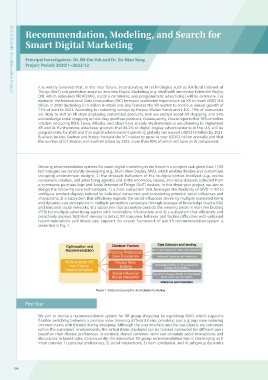
recommendations and timely user support. An overall framework of our XR recommendation system is
presented in Fig. 1.
Figure 1 : Data processing for smart digital marketing.
First Year
We aim to devise a recommendation system for XR group shopping by exploiting MVD, which supports
flexible switching between a primary view (viewing different items privately) and a group view (viewing
common items with friends) during shopping. Although the user interface and the real objects are consistent
within the customers’ environments, the virtual items displayed can be tailored somewhat for di erent users
based on their diverse preferences. In contrast, shared common items can stimulate social interactions and
discussions to boost sales. Consequently, the innovative XR group recommendation task is challenging as it
must consider 1) personal preferences, 2) social interactions, 3) item correlation, and 4) subgroup dynamics
94
合計 Recommendation, Modeling, and Search for
作
畫 Smart Digital Marketing
IIS Collaborative Projects Principal Investigators: Dr. Mi-Yen Yeh and Dr. De-Nian Yang
Project Period: 2020/1~2022/12
It is widely believed that, in the near future, incorporating AI technologies such as Artificial Internet of
Things (AIoT) and predictive analytics into new Digital Marketing [e.g. retail with immersive Extended Reality
(XR, which subsumes VR/AR/MR), social e-commerce, and programmatic advertising] will be extensive. For
example, the International Data Corporation (IDC) forecasts worldwide expenditure on XR to reach USD$18.8
billion in 2020 (including $1.5 billion in retail) and also foresees the XR market to continue annual growth of
77% at least to 2023. According to marketing surveys by Forbes, Walker Sands and L.E.K., 79% of consumers
are likely to visit an XR store displaying customized products, 65% are excited about XR shopping, and 54%
acknowledge social shopping as how they purchase products. Consequently, Oracle reports that 78% of online
retailers (including IKEA, Lowe, Alibaba, and eBay) have already implemented or are planning to implement
XR and AI. Furthermore, eMarketer predicts that 86.2% of digital display advertisements in the U.S. will be
programmatic by 2020 and that digital advertisement spending globally will exceed USD$375 billion by 2021.
Business Insider, Gartner and Forbes forecast the IoT market to grow to over USD$3 trillion annually and that
the number of IoT devices will reach 64 billion by 2025, more than 80% of which will have an AI component.
Devising recommendation systems for smart digital marketing in the future is a complex task given that: 1) XR
technologies are constantly developing (e.g., Multi-View Display, MVD, which enables exible and customized
shopping environment design); 2) the strategic behaviors of the multiple parties involved (e.g., online
consumers, retailers, and advertising agents); and 3) the enormous, biased, and noisy datasets collected from
e-commerce purchase logs and Social Internet of Things (SIoT) devices. In this three-year project, we aim to
design the following core technologies: 1) a main subsystem that leverages the flexibility of MVD in XR to
con gure product displays tailored to individual consumers and considering potential social in uences and
interactions; 2) a subsystem that e ectively exploits the social in uences driven by multiple correlated items
and dynamic user perceptions in multiple promotion campaigns through leverage of Knowledge Graphs (KG)
and temporal social networks; 3) a subsystem that accurately predicts the winning prices in real-time bidding
(RTB) for multiple advertising agents with incomplete information; and 4) a subsystem that efficiently and
proactively deploys SIoT/AIoT devices to detect XR consumer behavior and tackles di culties with unbiased
recommendations and timely user support. An overall framework of our XR recommendation system is
presented in Fig. 1.
Figure 1 : Data processing for smart digital marketing.
First Year
We aim to devise a recommendation system for XR group shopping by exploiting MVD, which supports
flexible switching between a primary view (viewing different items privately) and a group view (viewing
common items with friends) during shopping. Although the user interface and the real objects are consistent
within the customers’ environments, the virtual items displayed can be tailored somewhat for di erent users
based on their diverse preferences. In contrast, shared common items can stimulate social interactions and
discussions to boost sales. Consequently, the innovative XR group recommendation task is challenging as it
must consider 1) personal preferences, 2) social interactions, 3) item correlation, and 4) subgroup dynamics
94